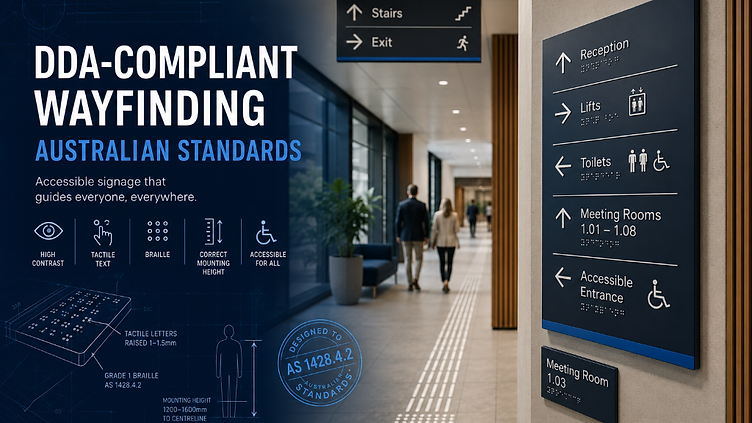
Is Your Building's Wayfinding Signage DDA Compliant?
Whether you're delivering a new commercial development, upgrading an existing building or planning a fitout, DDA-compliant wayfinding signage is an essential part of creating an accessible, safe and legally compliant environment.
Unfortunately, many projects leave signage until the final stages of construction, resulting in costly redesigns, delays and compliance issues. Getting it right from the outset not only helps meet the requirements of the Disability Discrimination Act (DDA) and relevant Australian Standards, but also creates a better experience for every visitor.
In this guide, we'll explain:
- What DDA-compliant wayfinding signage is
- Which Australian Standards apply
- Where compliant signage is required
- Common mistakes to avoid
- Typical costs
- How to plan an effective wayfinding system for your project
What Is DDA-Compliant Wayfinding Signage?
DDA-compliant wayfinding signage is designed to help people of all abilities navigate buildings safely and independently while meeting Australia's accessibility requirements.
Unlike standard signs, DDA-compliant signage incorporates features such as tactile lettering, Braille, appropriate colour contrast and specific installation heights to ensure information is accessible to people with vision impairment and other disabilities.
Wayfinding signage typically includes:
- Building directories
- Reception signs
- Room identification signs
- Lift directories
- Stair identification signs
- Directional signs
- Toilet signage
- Accessible entrance signs
- Exit signage
- Parking signage
- Emergency information signs
A well-designed wayfinding system doesn't just meet compliance requirements—it improves the overall user experience and reflects the professionalism of the building.
Is DDA Signage Mandatory in Australia?
In many commercial, public and multi-residential buildings, yes.
Accessible signage is generally required under:
- The Disability Discrimination Act 1992 (DDA)
- The National Construction Code (NCC)
- Relevant Australian Standards, including AS 1428
The exact signage required depends on the type of building, its classification and the scope of the project. New developments and major refurbishments will typically require accessible signage as part of the approval and certification process.
Australian Standards for DDA Signage
Several Australian Standards govern accessible signage and wayfinding.
The most commonly referenced include:
- AS 1428.1 – Design for Access and Mobility
- AS 1428.4.1 – Tactile Ground Surface Indicators
- AS 1428.4.2 – Wayfinding Signage
- National Construction Code (NCC)
- Disability Discrimination Act 1992 (DDA)
These standards specify requirements for:
- Tactile lettering
- Braille
- Font selection
- Colour contrast
- Installation heights
- Sign positioning
- Pictograms
- Readability
Because compliance requirements vary depending on the building, it's important to work with an experienced commercial signage provider during the design stage.
Key Requirements for DDA-Compliant Signage
1. Tactile Lettering
Permanent identification signs typically require raised tactile lettering.
This allows users to read information by touch as well as visually.
Tactile text should use:
- Clear sans-serif fonts
- Consistent spacing
- Appropriate character height
- Raised lettering manufactured to Australian Standards
2. Braille
Many permanent room identification signs also require Braille positioned directly beneath the tactile lettering.
Accurate Braille translation is essential and should always be professionally produced rather than automatically generated.
3. Colour Contrast
One of the most common compliance failures is insufficient contrast between the text and background.
High luminance contrast improves readability for people with low vision while also making signage easier for everyone to read.
4. Mounting Height
Signs must be installed within prescribed height ranges so they are easily located and read by all users.
Even perfectly manufactured signage may fail compliance if installed incorrectly.
5. International Symbols
Recognised pictograms improve accessibility and assist visitors regardless of language.
Common symbols include:
- Accessible toilets
- Baby change facilities
- Reception
- Information
- Lifts
- Emergency exits
- Accessible parking
Where Is DDA Wayfinding Signage Required?
Accessible signage is commonly required throughout commercial and public buildings, including:
- Office buildings
- Shopping centres
- Hospitals
- Medical centres
- Universities
- Schools
- Hotels
- Aged care facilities
- Apartment developments
- Government buildings
- Airports
- Public transport facilities
- Industrial facilities
Any building designed for public access should consider accessibility from the earliest stages of planning.
Common DDA Compliance Mistakes
Many compliance issues arise from simple design or installation errors.
The most common include:
- Incorrect Braille translation
- Poor colour contrast
- Decorative or difficult-to-read fonts
- Incorrect tactile lettering
- Signs installed too high or too low
- Missing directional signage
- Inconsistent sign design throughout the building
- Poor placement near doors and corridors
Rectifying these issues after construction can be expensive and disruptive.
How Much Does DDA-Compliant Signage Cost?
One of the most common questions asked by builders and property managers is:
How much does DDA-compliant signage cost?
The answer depends on several factors, including:
- Number of signs required
- Building size
- Materials and finishes
- Braille requirements
- Tactile lettering
- Custom branding
- Installation complexity
- Access equipment
Rather than viewing DDA signage as a compliance cost, it's better considered a long-term investment in accessibility, safety and building quality.
Obtaining a signage schedule early in the project provides accurate budgeting and helps avoid unexpected costs during construction.
Why Planning Wayfinding Early Saves Time and Money
One of the biggest mistakes on commercial projects is leaving signage until practical completion.
Instead, signage should be coordinated during:
- Architectural design
- Interior design
- Construction documentation
- Services coordination
- Joinery detailing
- Fitout planning
Early coordination avoids clashes with glazing, services, wall finishes and door hardware while creating a consistent signage strategy across the entire development.
The Benefits of Professional Wayfinding Design
Effective wayfinding is about far more than compliance.
A professionally designed system helps people:
- Navigate confidently
- Find reception quickly
- Locate amenities easily
- Access emergency exits safely
- Reduce confusion
- Improve visitor experience
For builders and developers, high-quality signage also enhances the overall presentation and value of the completed project.
Why Choose an Experienced Commercial Signage Partner?
DDA signage requires more than simply manufacturing plaques.
An experienced signage company can:
- Review architectural drawings
- Develop complete signage schedules
- Recommend compliant materials
- Produce tactile and Braille signage
- Coordinate manufacturing
- Install signage correctly
- Maintain consistency throughout the project
Working with a knowledgeable signage partner helps reduce project risk while delivering a professional outcome that aligns with both compliance requirements and architectural intent.
Plan Your Wayfinding Strategy with Confidence
Accessible signage is no longer simply a compliance requirement—it's an essential part of creating welcoming, functional and professionally designed environments.
Whether you're delivering a new commercial development, upgrading an office fitout or managing a large public facility, early planning and expert guidance can save time, reduce costs and help ensure a smoother project delivery.
At Signvox, we partner with builders, architects, developers, property managers and facility managers across Sydney to design, manufacture and install premium DDA-compliant wayfinding signage that meets Australian Standards while complementing your building's design.
If you're planning your next project, our team can help develop a complete signage strategy—from concept and documentation through to manufacture and installation.
Planning a DDA wayfinding project?
Get compliance-ready wayfinding signage engineered for your building.
Wayfinding & Statutory Signage
DDA / AS1428-compliant wayfinding, braille, tactile and statutory signage.
Explore this serviceRelated Projects
Keep Reading

Insights, straight to your inbox
Join our list for signage advice, project insight and compliance updates. No spam.
Comments (0)
Be the first to comment.